


The earliest known woman silversmith in England was Agas Harding, whose mark was entered in 1513. Silversmithing in the 18th century was very much a family business, everyone shared in the work, far more women were involved than records show, as few were formally apprenticed …
$2.99
Depending on form and function, silver boxes became better known by more precise names that defined their actual use, although the litany of arcane terms can be ambiguous. Consider the following: pyx, chrismatory, ethrog, patchbox, vinaigrette, vesta, mull, casket, bibelot, sealbox, reliquary, coffer and etui, to name just a few.
$1.49
When a Sydney dealer came across a collection of three Australian-made sterling silver horse buckles and their respective sashes, he had an inkling they represented a remarkable piece of history – and he was right.
$1.49
Paul Storr needs little introduction. He was the most prominent silversmith of the Regency period, producing many important pieces that were commissioned by some of the most powerful people of his time. “His use of innovative technology is breathtaking; it was the Microsoft of its day,” says silver scholar and author Christopher Hartop.
$1.49
From a family that encompassed three generations of goldsmiths and bronze workers and heir to his father Andrea’s highly successful workshop in 1759, Valadier had an unsurpassed technical expertise which, combined with his
avant-garde aesthetic, resulted in extraordinary works in silver and bronze.
$1.49
There was little need or demand for control of the fledgling trade by authorities and the relatively few silver and goldsmiths of the time had been happy to ply their trade unfettered with little complaint heard from customers. Things changed with the gold rushes of the 1850s. Great wealth was accumulated, relatively large sums began to be spent on precious metal objects …
$1.49
Behind a set of four early 20th century Chinese export silver spoons lurks a fascinating story of war, assassins and covert operations in Japanese-occupied Shanghai.
$1.49
A stunning set of silver chargers reveal a connection between the 2nd Earl of Selborne and Mahatma Gandhi.
$1.49
It’s only relatively recently that women have had an opportunity to contribute significantly to the fields of fine art and the decorative arts. Before the emancipation of the early 20th century, women were socially constrained to domestic roles and
economic dependency. Achieving any education was a challenge unless a woman was fortunate enough to be born into a life of privilege.
$1.49
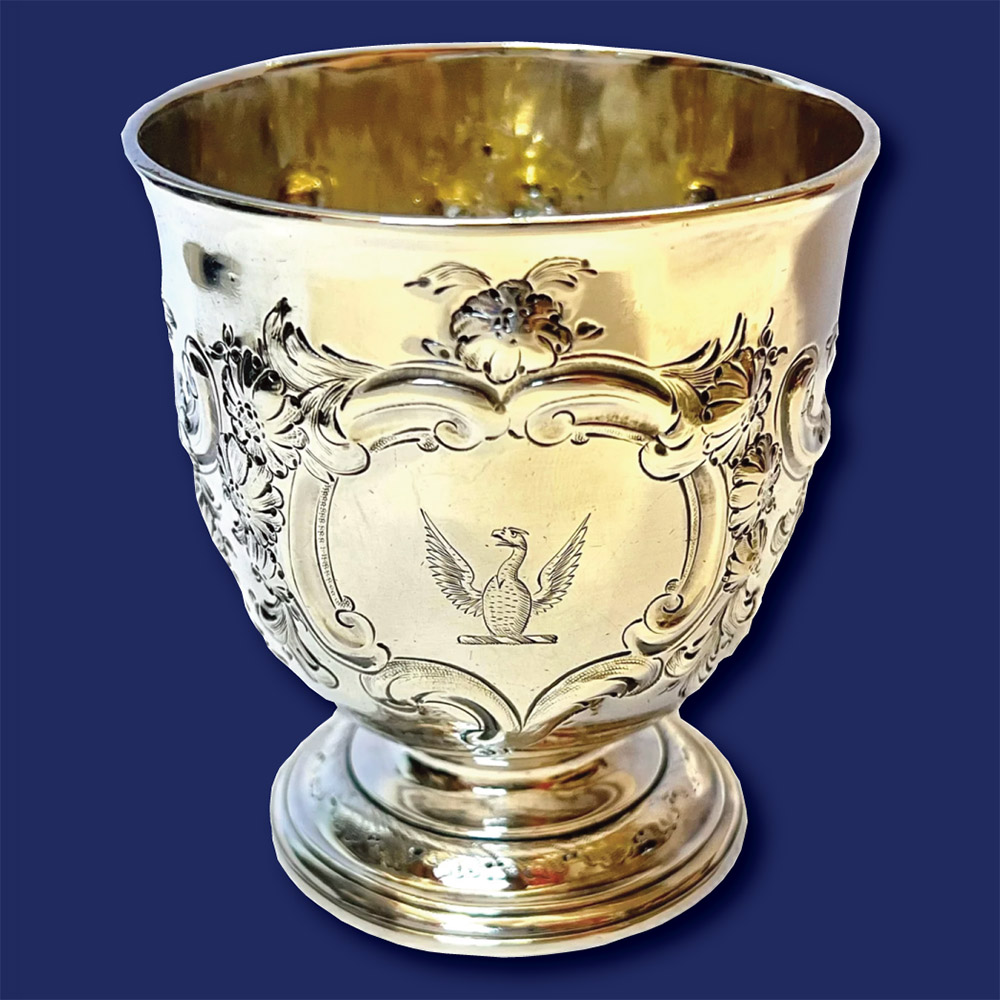
At its most basic, the term ‘stirrup cup’ refers to a small cup containing an alcoholic drink, usually offered to a horseman ‘in the stirrups’ before they ride away.
$1.49
The inscription on an elegant tastevin offers a fascinating glimpse at the splendour of Imperial Russia, as well as the aspirations of one of her princes.
$1.49
The crock of gold at the end of the rainbow has long been part of British (Celtic) folklore but for one man in eastern France, a crock of silver at the end of the garden became a Gallic reality.
$1.49
In the Victorian era, when manners and etiquette were crucial to one’s social standing, the visiting or calling card played an important role as an indicator of social class and good manners. In Rules of Etiquette and Home Culture, published in 1886, it was noted that: ‘Callers should always be provided with cards”.
$2.99
Food historians believe ancient nomads created butter by accident, when they stored milk in sacks on pack horses. Whatever the truth of the discovery, the first verified depiction of people purposely producing butter appears on a stone tablet from Mesopotamia dating from 2,500 BC.
$2.99
What do silversmith Alexander Crichton, Alice in Wonderland and claret jugs have in common? Quite a lot, actually: Crichton is credited with starting a late 19th century trend in claret jugs that was partly inspired by Sir John Tenniel’s illustrations in Lewis Carroll’s Alice in Wonderland (1865) and Alice Through the Looking Glass (1872).
$1.49
Hard cheese was an important part of the diet in the 18th and 19th centuries. Its consumption was recommended to keep the digestive system running smoothly and for the promotion of healthy teeth, and it was eaten daily in wealthy households.
$2.99
When we think of antique silver, we typically think of elegant dining rooms, genteel conversation and scintillating Regency balls. But the stories behind some of these beautiful antiques have you thinking, ‘If only they could talk…’
$1.49
Trade with China goes back a very long way, notably to the Han dynasty along the Silk Road, but the heyday of the British
China Trade began around 1700 when the East India Company established links in Canton. British wool and Indian cottons
were traded for Chinese silk and tea and transported in sailing ships. Such a light cargo needed ballast, so goods such as
silver and porcelain provided that.
$1.49
From a wool-broker’s manager to a lauded silversmith, Gilbert Leigh Marks trod a less common path to glory.
$1.49
Despite being closed off for much of modern history, Japan’s artistic impact on the west in the late 19th century was explosive. We look at the intrigue behind some masterworks of Meiji – part two.
$2.99
If it was invented today it’s a fair bet the skirt lifter would have a different name, but things were a lot less politically correct in the Victorian era, when the skirt lifter was a requirement for any lady who wished to clip up her full-length skirts to avoid getting them dirty.
$1.49
He was a hugely talented silversmith, but it’s not his silver for which Jean Després is best known; it’s his bold and uncompromising jewellery, with its focus on obviously industrial shapes.
$1.49
Throughout the second part of the 19th century emu eggs shells were used by colonial silversmiths to create distinctively Australian presentation pieces, and few makers were more prolific than William Edwards.
$1.49
Subscribe now to read and download these articles and hundreds more for free.
Probably since at least the 17th century, European adults have taken an interest in tiny toy objects they could display in dolls’ or baby houses (miniature versions of their own houses). Although originally intended for children to use, the tiny toy replicas fascinated the adults even more.
MEMBERS ONLY
Scotland’s unique relationship with silver started during the occupation by the Romans and continued through medieval times. It remains an important ingredient in folk and ceremonial items.
MEMBERS ONLY
First introduced to Europe by sailors in the 15th century, the taking of snuff became a sophisticated pleasure enjoyed by the aristocracy and dedicated followers of fashion, so it’s no surprise that the snuff box itself evolved into an item of refinement.
MEMBERS ONLY