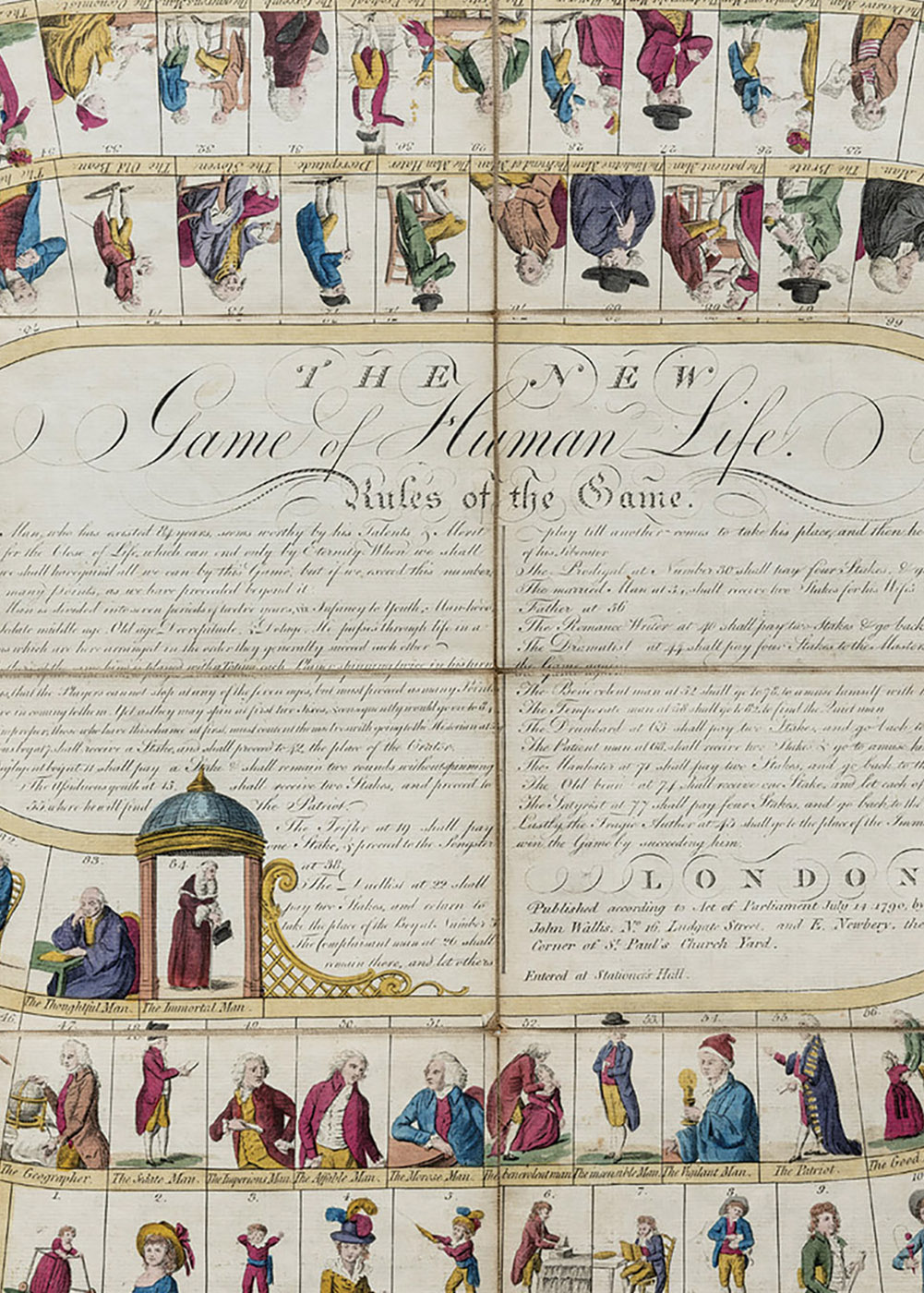
Wallis began as a mapmaker, opening his first shop in London in the 1770s. From 1785 he included dissected maps (an early form of the jigsaw) in his catalogues, to teach geography to children. The dissected maps, which were constantly updated, formed part of the stated aim of selling ‘A Variety of Useful Publications for The Improvement of Youth’. In this, John Wallis would be spectacularly successful.
Wallis’s board games included another message for the young players, and it was this: knowledge could overcome chance. It was knowledge that determined the winner in his games and playing them successfully depended largely on the commitment of the player and their ability to learn. Children who played were expected to be ‘industrious, obedient, constantly respectful … never too spoilt, occasionally indulged as a reward for virtue.’ They were even encouraged while playing to use familiar objects around the home to personally test the scientific notions they were learning.
The Wallis board games were beautifully illustrated, printed on pieces of card that were mounted on linen and folded in illustrated boxes along with an instruction booklet and sometimes also with the markers and counters. The games were also quite expensive, retailing for around 8 to 10 shillings each which was not generally easily affordable. The characters that appeared on the boards were stylish and well-dressed, to appeal to the middle class families that formed the primary market.
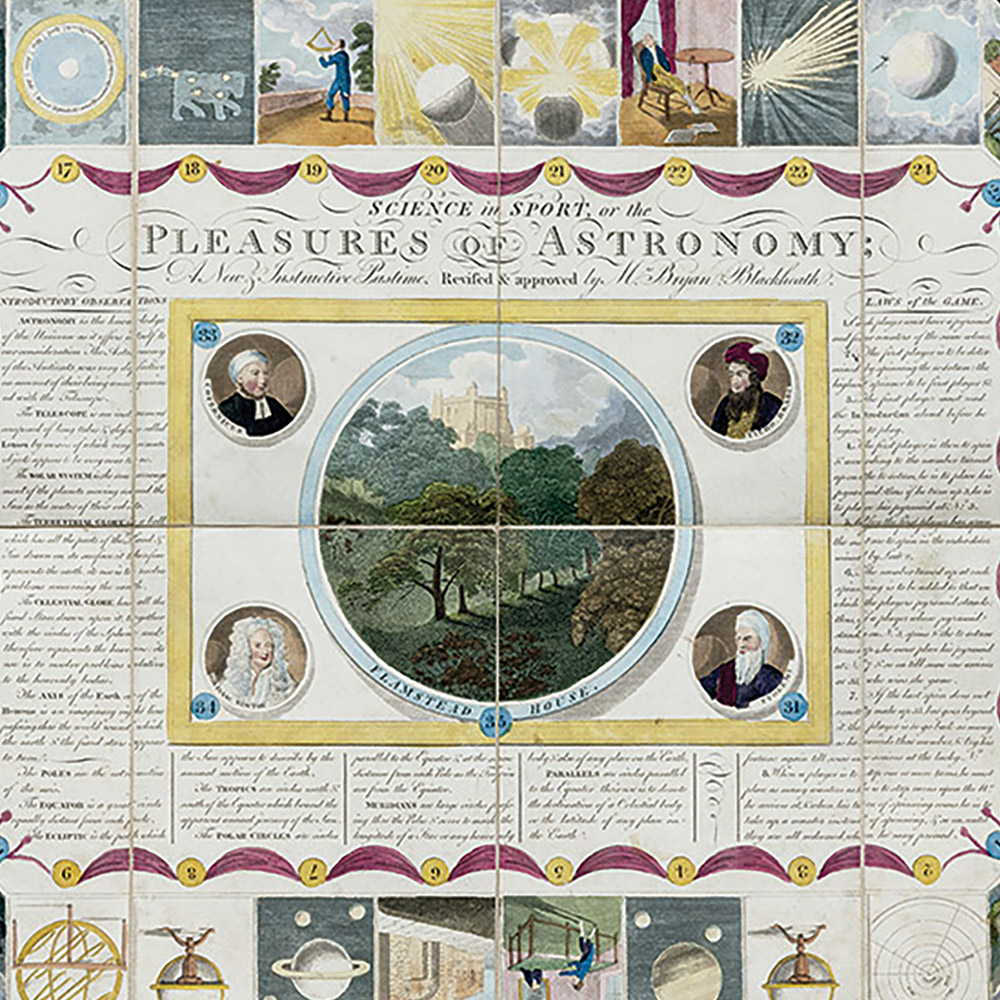
Although there were other publishers selling dissected maps and geographical or historical board games, no other maker published science-themed games while Wallis was in operation. It was commonly believed that the study of science could elevate the spirit and promote good conduct and children were expected to remember the knowledge they were acquiring through playing the board games. In An Arithmetical Pastime, for example, there were 10 equivalence tables that had to be memorised, with a particular example to be repeated when a player landed on a particular square. If the player got it wrong they either missed a few turns or had to go backwards. And in The Pleasures of Astronomy, players had to explain the workings of the telescope, the celestial and the terrestrial globes if they didn’t want to skip two rounds.
To find out more about John Wallis and his spectacular games, why not subscribe to Antiques to Vintage magazine: there’s a four-page feature in the current Summer issue of the magazine (along with another 116 pages of top information on antiques and collectables).