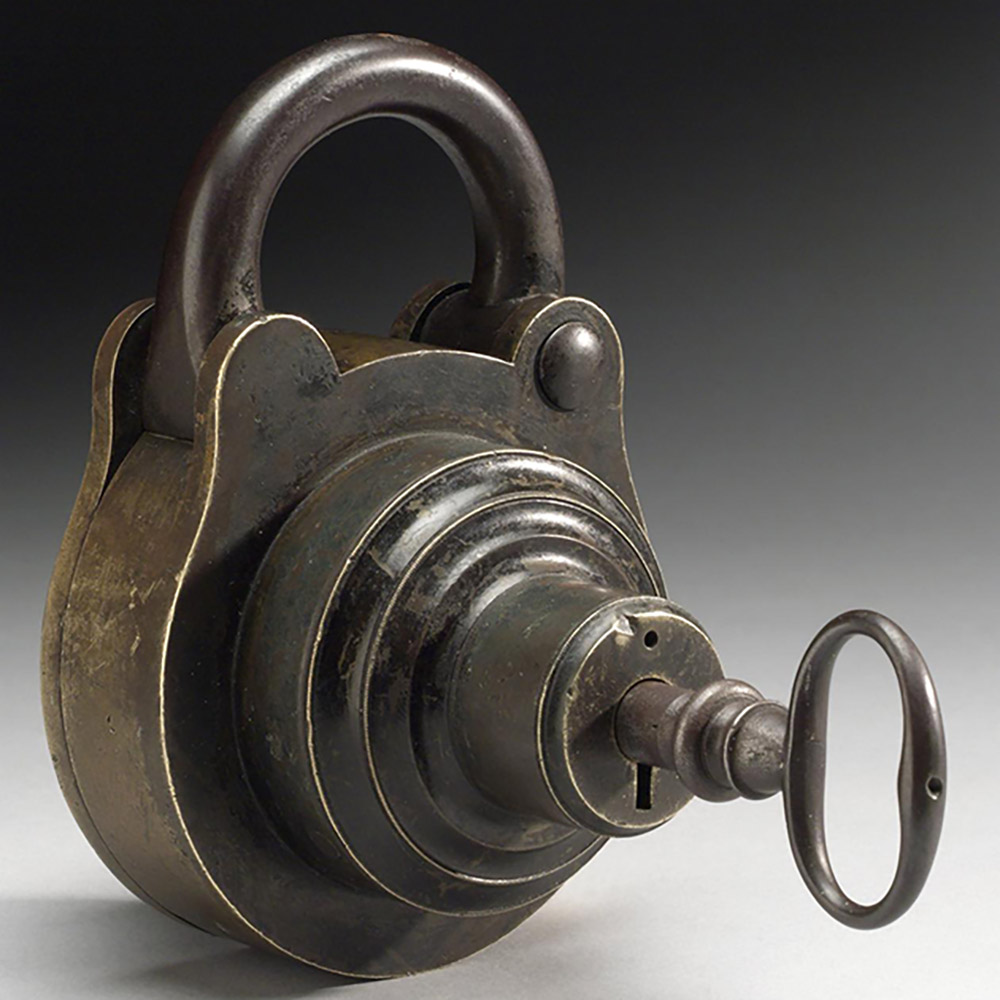
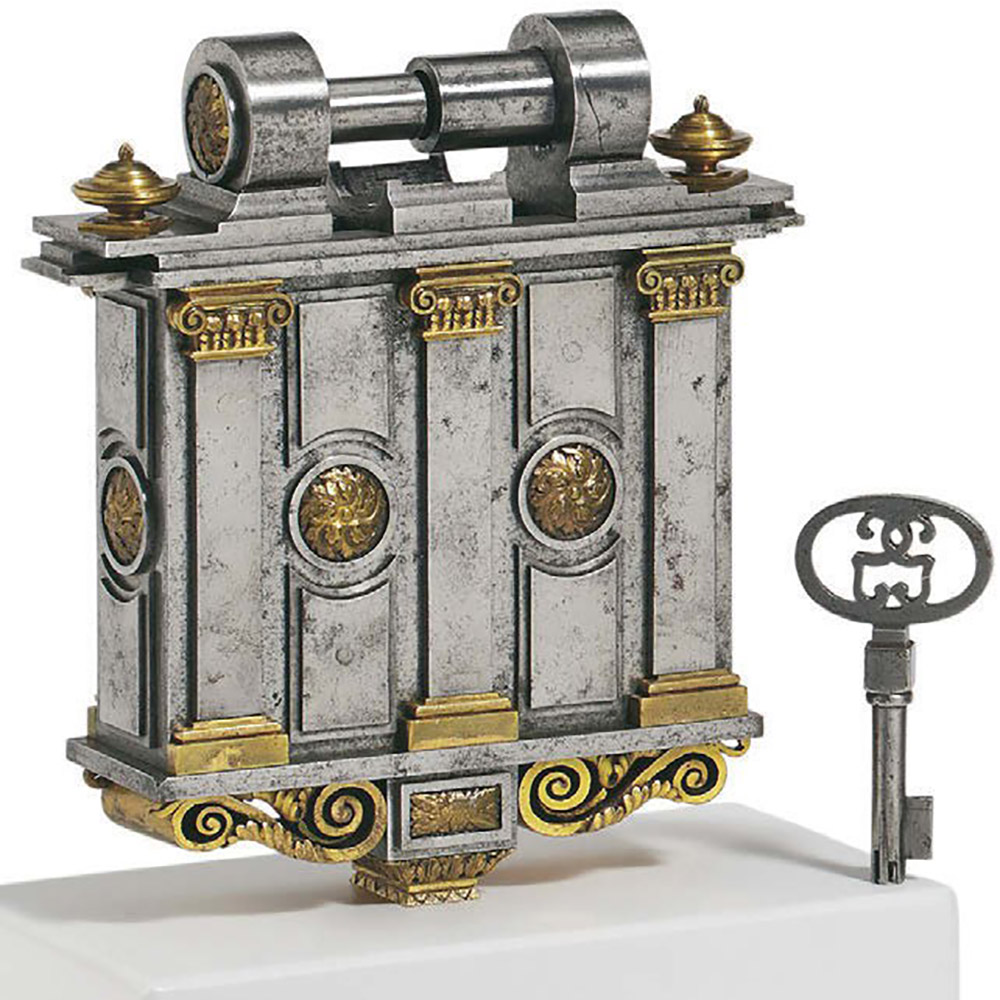
When Englishman Joseph Bramah developed his locking system in 1790, he was so convinced the Challenge Lock could never be forced that he offered a reward of 200 guineas (that’s close to $100,000 in today’s money) for anyone who could successfully pick it.
Bramah and his chief engineer, Henry Maudslay, had undertaken to make a padlock so secure that it could only be opened by its own dedicated key. They placed their mounted Challenge Lock in the window of their London shop and issued the following challenge: ‘The artist who can make an instrument that will pick or open this lock shall receive 200 Guineas the moment it is produced.’
Given the lock’s construction, Bramah had a right to be confident. His updated design used eighteen sets of sliders, whereas most locks of the era had only four to six – and the Bramah design had more than 470 million possible permutations.
Over the years, hundreds of locksmiths tried and failed at the challenge. When Joseph Bramah died in 1814, his lock had still not been forced. His sons took over the business and the Challenge Lock remained in the company’s shop window as something of a novelty until August 1851, when American locksmith Alfred Charles Hobbs finally set about opening it.
Hobbs was in London for the Great Exhibition, representing New York locksmith company Day and Newell whose Parautopic lock won a prize medal (and became one of the most famous American safe locks of its time). He saw an opportunity for promoting his company’s lock by proving the shortcomings of the reigning British locks, beginning with the Chubb Detector that was fixed to an iron door of a vault in Westminster. Hobbs announced his intention to Chubb and was as good as his word: he gained access in 25 minutes and then relocked it in seven. The media went wild and Hobbs became something of a celebrity.
Having informed Bramah of his intention to pick the Challenge Lock, on July 24 1851 it was removed from the shop window and taken to an upper room where Hobbs began his task. An agreement had been drawn up between Hobbs and Bramah and a committee of three was appointed to oversee the challenge, for which Hobbs was given 30 days.
The effort took him more than 50 hours, spread over 16 days. On August 23, in the presence of two of the committee members, Hobbs displayed the open Challenge Lock; when he displayed it again to all three members on August 29, there were several connected pieces of apparatus that he had used to complete the task. Bramah objected that the lock could have been forced and not successfully picked, but the following day, after Hobbs had returned the lock to its original state, the key was successfully inserted and the lock opened.
The Bramah company paid Hobbs £210 (equal to 200 guineas) but noted, quite correctly, that it had taken Hobbs so long to complete the task that it was impractical for any real-world burglary and his success had no practical use whatsoever. The success of Hobbs ultimately increased the Bramah lock’s reputation and the firm still produces bespoke locks in London today.